VetView · Imaging and AI radiology
Your PACS and your AI radiology, in one place.
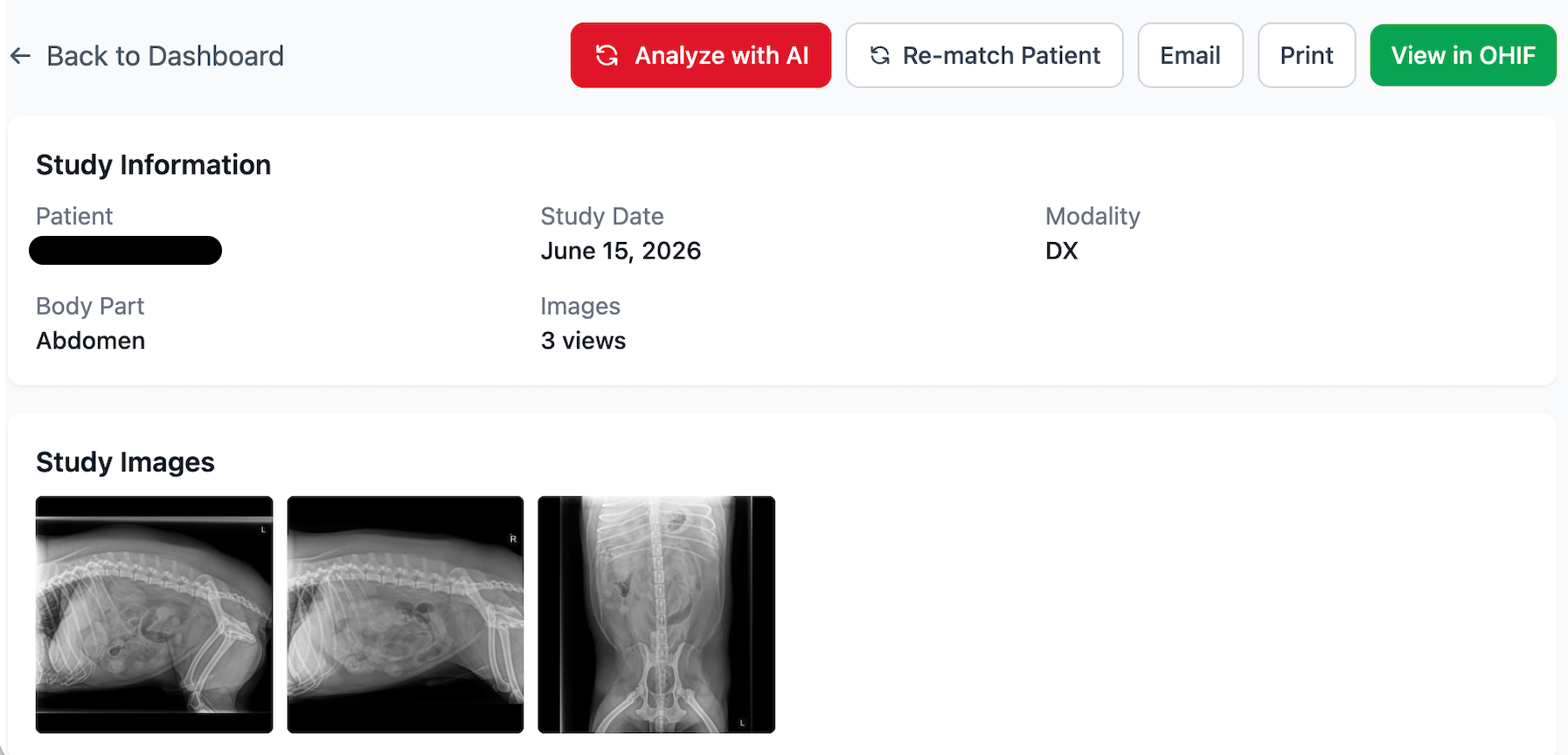
VetView keeps a secure copy of every study, shares any of them at full resolution in one click, and puts an AI second opinion on your radiographs. One product, one price per location.
You do not need to buy a webPACS
VetView is one. Every study is backed up, viewable in any browser, and shareable at full resolution.
You do not need a separate AI subscription
AI radiology reporting is part of VetView, not an add-on with its own bill.
You do not need to count studies
One price per location. No study limits, no per-user licences, no overage conversations.
Imaging
A backup that is actually useful day to day
A safe copy of every study
Studies sync to secure cloud storage automatically, so your imaging is protected even if something happens on-site.
Full-resolution sharing
Share the original diagnostic images, not a compressed screenshot. What you see is what they see.
One click to send
Email a study to a client, a referral practice, or a specialist in a single click. No discs, no portals to set up.
Keep the PACS you have
VetView syncs from your existing PACS and sits alongside it. No rip-and-replace, no new workstation, no retraining.
AI radiology
BetaAn AI second opinion on every radiograph
Included with VetView at no extra cost, and currently in beta. It is a second opinion, not a diagnosis.
Every study looked at
Radiographs are read as they arrive and flagged for findings, so nothing sits waiting on somebody being free.
Automated VHS
Vertebral Heart Score measured from the image, giving you an objective cardiac number without manual landmarking.
Checked before it reaches you
A board-certified radiologist checks the report before it is sent. Not a consult on your patient, a quality check on the report.
A full read is one click away
When you want findings and recommendations from a board-certified radiologist, escalate straight from the report.
How it works
Not all AI is the same, and the difference matters to your report
AI is the hot topic these days, and by now most people reading this page have used ChatGPT or something like it. Two kinds are worth separating: generative AI and machine learning.
GenAI is the new one. Ask it the same question twice and you will get two answers. Both may be fine, just worded differently. That is called non-deterministic, and it is the whole point. It is what lets you have a conversation with it and get a useful response to almost anything you throw at it.
We use genAI too. Most of the written text in your report is generated, because that is what turns findings into something a person can read instead of a table of coordinates. But non-deterministic models can hallucinate, stating something confidently that simply is not so. In medicine that is not a quirk, it is a risk. So we do not let it near the part that matters.
Machine learning is the older one. It has been around far longer, and it is deterministic: same input, same output, every time. That is what reads your radiographs. Your x-ray comes in, the model reads it, and it finds on Tuesday exactly what it found on Monday.
Generative AI
The same question, asked three times
- Run 1Mild cardiomegaly is present.
- Run 2The cardiac silhouette appears enlarged.
- Run 3There is evidence of an enlarged heart.
Non-deterministic. Three answers. Good for writing, risky for reading.
Machine learning
The same image, read three times
- Run 1Cardiac silhouette · VHS 11.2
- Run 2Cardiac silhouette · VHS 11.2
- Run 3Cardiac silhouette · VHS 11.2
Deterministic. One answer. This is what reads your radiographs.
That output can be wrong. But it is wrong the same way every time, which makes it measurable, and measurable makes it fixable. Chasing the same problem through a generative model is far harder. This is why the reading of the image itself is machine learning only. We want what the model sees to be consistent, so that when it is off, we can find it and correct it.
And then there is HI. Human intelligence. Older still, by a few thousand years.
Behind every report is a board-certified radiologist who checks it before it reaches your inbox. Not a consult on your patient, a check on the report: do the words match what is actually on the image? People make mistakes too, so this is not perfection. But veterinary medicine is early in its use of this technology, and while that is true, a specialist between the model and you is the right place to be.
As the models earn it, that check will move from every report to a sample. We do not think humans ever leave this picture entirely, which is why a full read by a board-certified radiologist is always one click away.
One product, one price, no study limits
We will set it up alongside your current PACS in minutes.
Request a demo